

WISE foundation (Welfare Information Systems Enterprise) develops and operates digital systems for social services in Armenia. The organization supports the Ministry of Labor and Social Affairs.
Managing information across different social services platforms requires reliable reporting and analytics. Since much of this data is sensitive, WISE needed an analytical platform that could provide greater flexibility, privacy, and control.
With support from the United Nations Development Programme (UNDP), WISE started a project to replace Microsoft Power BI with MPP BI. The goal was to move away from the limitations of their existing setup and adopt a more flexible, private, and scalable analytics platform.
In this project walkthrough, we'll look at the challenges WISE faced, the reasons behind replacing Power BI, and how MPP BI helped create a more flexible and reliable analytics environment for social services data.
The Challenge: Why Power BI Was No Longer the Right Fit
WISE was already using Power BI for reporting and analysis. Over time, some limits started to appear.
Dependence on the Microsoft ecosystem
Power BI is built to work fully within the Microsoft ecosystem, which means organizations are pushed to rely on Microsoft tools and infrastructure to get the most out of it.
It integrates with OneDrive for file storage and collaboration, but has no native support for Google Drive. Also, this can be limiting for teams that use other operating systems. For example, Power BI Desktop doesn’t have a native version for macOS or Linux. Users on these systems usually have to rely on virtual machines or remote desktop access, which adds extra cost and complexity.
On-premise deployment and sensitive data
A large part of WISE's data comes from social services systems. This type of data is sensitive and subject to strict internal requirements around where it is stored and how it is accessed. WISE needed a platform that could meet those requirements without compromise.
Keeping analytics infrastructure on-premise also gives organizations more control over future technologies and helps avoid the growing costs that can come with cloud-based services.
Growing costs
As usage increased, costs also increased. Licensing and dependency on a single vendor made it harder to manage long-term expenses.
Future growth and Scalability
The WISE team was adding more systems and more users over time. The existing setup was not built to scale in a simple, flexible way.
Why an On-Premise Approach Made Sense
Government organizations work with sensitive information. For this reason, privacy and ownership of data are crucial. This was especially true for WISE, which manages data from social services systems.
Keeping data inside the organization
With on-premise deployment, data stays inside the organization's own infrastructure instead of being stored on external cloud services. This gives WISE more control over how sensitive information is handled and protected.
Ready for advanced AI
Running analytics on your own infrastructure also opens the door for advanced AI features like agentic BI. On the cloud, these features can get expensive quickly.
To learn more about how AI agents can transform your data analytics, read our blog on agentic BI.
Why WISE Chose MPP BI
WISE needed an analytical platform that could give them more control over their data, work with different technologies, and support future growth. MPP BI matched these requirements.

To learn more about how it works and how it compares to other BI tools, visit the MPP BI product website.
Flexible integration with different systems
WISE works with information from multiple social services platforms. MPP BI connects directly to different data sources, including databases, APIs (the connections that let software systems share data), applications, and existing systems. This lets WISE work with data from many platforms without having to depend on a single ecosystem.
Ready for future growth
In large organizations data volumes, reporting requirements, and the number of users grow over time. MPP BI can handle new users, more systems, and larger datasets without major changes to the platform.
A Modern Data-Centric Architecture
WISE manages information across multiple social services platforms. Reporting often required pulling data from different systems, which made the process slow and fragmented.
Most traditional BI tools, including Power BI, first make their own copy of the data before they can analyze it. But MPP BI works differently. It uses the original data directly, without creating duplicate copies. This cuts unnecessary data movement, avoids keeping multiple versions of the same data, and gives WISE more oversight of its information.
Because WISE works with sensitive social services data, analyzing it in place also made the setup simpler and more efficient.
A Look at the Dashboard
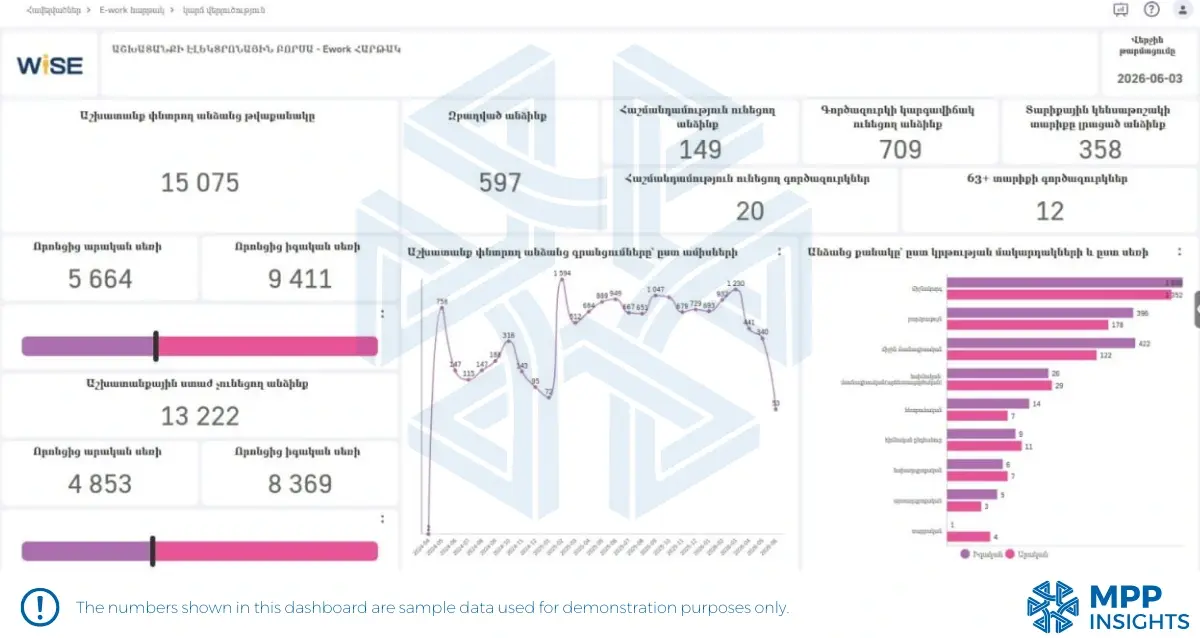
Here is an example of a dashboard built on MPP BI for WISE. It brings data from different social services systems into one view, so a team can see key figures, trends over time, and regional breakdowns in one place, instead of pulling separate reports by hand.
The numbers shown here are used only for demonstration. Because WISE works with sensitive social services data, the real dashboards stay inside its own infrastructure and are not shared publicly.
Project Results at a Glance
WISE moved from Power BI to an independent analytics platform built on MPP BI. Here is what changed:
- WISE relies less on the Microsoft ecosystem for reporting and analytics.
- WISE now handles sensitive social services data on its own infrastructure.
- MPP BI connects data from multiple social services systems in one place.
- Reporting is more consistent across departments.
- The setup is ready to handle new data sources and growing usage over time.
A Final Note
Many organizations still run on legacy BI systems, older reporting tools that weren’t built for today’s data setups. Moving away from them can feel like a big change, especially when systems are already integrated into daily work.
The WISE project shows that an organization can replace an older or cloud-based BI setup and come out with more privacy, more flexibility, and full ownership of its data.
This matters for government and enterprise organizations. They work with large volumes of sensitive information and need reporting systems that are not tied to a single vendor or ecosystem.
MPP BI fits into this kind of environment by connecting to existing systems, working with data where it already is, and supporting growth as needs change over time.
If you work in government or enterprise and would like to learn more about this project or what MPP BI could do for your team, reach out to us at welcome@mpp-insights.com.